






On April 16, 2025, staff at The Krasman Centre engaged in a quiet but meaningful act of collective reflection by participating in the Semicolon Movement, an international initiative focused on mental health awareness and suicide prevention. The simple act of drawing a semicolon—or sharing an existing tattoo—became a powerful way for us to stand together in hope and solidarity.
A week before April 16, we introduced Project Semicolon during a team meeting. We shared its origins, purpose, and the story of its founder, Amy Bleuel. Not many on our team were previously familiar with the movement, but the space opened up rich reflections, a few personal stories, and a moment to learn more about what the semicolon has come to represent in mental health advocacy.
The semicolon (;), as used in grammar, signifies a pause rather than a full stop—a decision to continue the sentence. Amy Bleuel, who launched Project Semicolon in 2013 after losing her father to suicide and surviving her own struggles, chose it as a metaphor for life: a pause, not an end. It became a symbol for those living with mental health challenges and for anyone who’s ever chosen to keep going through pain and uncertainty (Project Semicolon, n.d.).
April 16 has since become a recognized day of reflection and participation for this movement. It invites people to remember loved ones lost to suicide, honour those living with mental illness, and take meaningful action toward more compassionate mental health systems. The message is simple but profound: your story isn’t over (Project Semicolon, n.d.).
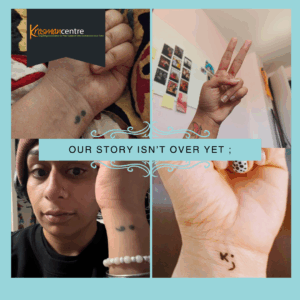
At The Krasman Centre, where our work is deeply grounded in peer support, trauma-informed care, and lived experience, the movement resonated. On the day itself, several staff members drew semicolons on their wrists, while others—who had semicolon tattoos—shared images of them. The collage above includes a few of these expressions, each a small but powerful visual of our collective care and commitment.
As we showed up for one another on April 16, we were reminded that small gestures—like a drawn symbol or a shared story—can carry enormous meaning. We encourage you to learn more about Project Semicolon, reflect with your own communities, and remember: your story matters. And it isn’t over.
References
Project Semicolon. (n.d.). Your Story Isn’t Over. https://www.facebook.com/projectsemicolon